Almost every coding project starts with the same question: which technology should we buy? The honest answer is that none of the three main options — continuous inkjet (CIJ), laser and thermal inkjet (TIJ) — is universally better. They solve different problems.
This article gives you a practical decision framework: match the technology to the substrate, the code and the line, and the shortlist usually becomes obvious.
Quick comparison
| Criteria | CIJ | Laser | TIJ |
|---|---|---|---|
| Contact with product | No | No | No |
| Substrates | Curved, non-porous, film, cable, cans | Metal, glass, coated board, some plastics | Cartons, paper, porous packaging |
| Typical speed | High | High (depends on mark) | Moderate |
| Consumables | Ink + solvent | None | Cartridge |
| Code durability | Good with correct ink | Permanent | Good on porous surfaces |
| Print height | 1–10 mm typical | Small to medium marks | Per-cartridge height |
| Maintenance demand | Daily checks | Low | Low |
| Initial cost | Moderate | Higher | Lower |
| Best first choice when… | You code bottles, caps, cables or film at speed | You need permanent marks on hard materials | You code cartons and labels with frequent message changes |
CIJ: the workhorse for hard-to-print surfaces
Continuous inkjet printers generate a stream of charged ink droplets and deflect them to form characters. Because the printhead never touches the product, CIJ handles curved, recessed and uneven surfaces that defeat most other technologies.
Choose CIJ when:
- Products are curved, irregular or non-porous
- Line speed is high and messages change frequently
- You need small characters (batch, date, lot) at reasonable cost
Be aware of:
- Solvent handling, ventilation and daily printhead checks
- Consumable cost that scales with production volume
- A controlled shutdown procedure to avoid nozzle clogging
Laser: permanent marks, no consumables
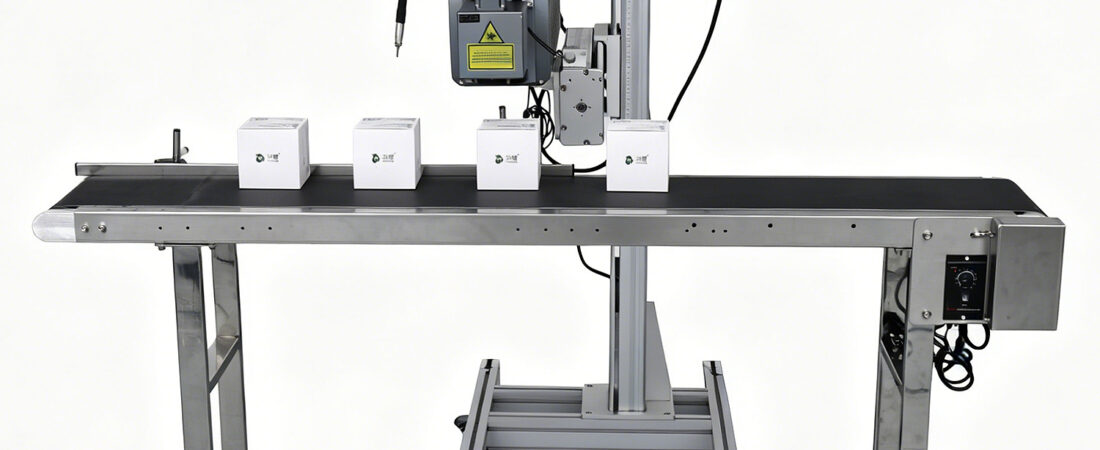
Laser systems remove or alter the surface of the material. There is no ink, so the mark cannot rub off, and consumable cost is effectively zero. The trade-off is higher initial investment and tighter material compatibility.
Choose laser when:
- The mark must survive solvents, heat, abrasion or sterilization
- The substrate is metal, glass or a laser-compatible plastic
- You mark high volumes where the absence of consumables pays back the CAPEX
Be aware of:
- CO₂, fiber and UV lasers suit very different materials
- Fume extraction and safety guarding are required
- Some packaging films and coatings cannot be laser marked cleanly
TIJ: simple, flexible, cartridge-based
Thermal inkjet printers use a cartridge with an integrated printhead. They are quick to install and easy to change over, which makes them popular for cartons, labels and secondary packaging.
Choose TIJ when:
- You print on porous surfaces such as cardboard or paper
- Messages change often and changeover speed matters
- You want low maintenance and low initial cost
Be aware of:
- Print height is limited by the cartridge
- Ink choice must match the substrate and any food-contact requirements
- Cost per print can be higher than CIJ at very high volumes
A simple decision path
- Is the mark a safety or traceability requirement that must be permanent? If yes, start with laser.
- Is the product curved, non-porous or heat-sensitive? If yes, CIJ usually wins.
- Is it a carton or label with changing messages? TIJ is often the most economical.
- Still undecided? Run the same real product through all three technologies and compare readability, adhesion and total cost.
Frequently asked questions
Is laser always more expensive than CIJ? The purchase price is usually higher, but laser has no ink or solvent cost. At high volumes the total cost of ownership can be lower — model it over five years.
Can CIJ print on metal? Yes, with the right ink and surface preparation, but laser usually produces a more durable mark on bare metal.
Which technology is best for food packaging? It depends on the packaging: CIJ for bottles and film, TIJ for cartons, laser for glass and some rigid containers. Food-contact compliance depends on the ink and the application, not only the printer.
Can one line use more than one technology? Yes, and this is common: CIJ for primary packaging, TIJ or laser for cases and pallets.
Next step
The cleanest way to choose is to test your actual product, at your actual line speed, with your actual code. WDOTMARK supplies CIJ, TIJ and laser systems and will run a side-by-side sample test so you can compare adhesion, readability and cost before deciding.
Send us your substrate and code sample to book a comparison test.
https://wa.me/+8619129707919